AI Education for Children: Where Do You Start?
AI education for children is not about opening a ChatGPT account. Cause and effect come first, the tool comes after.
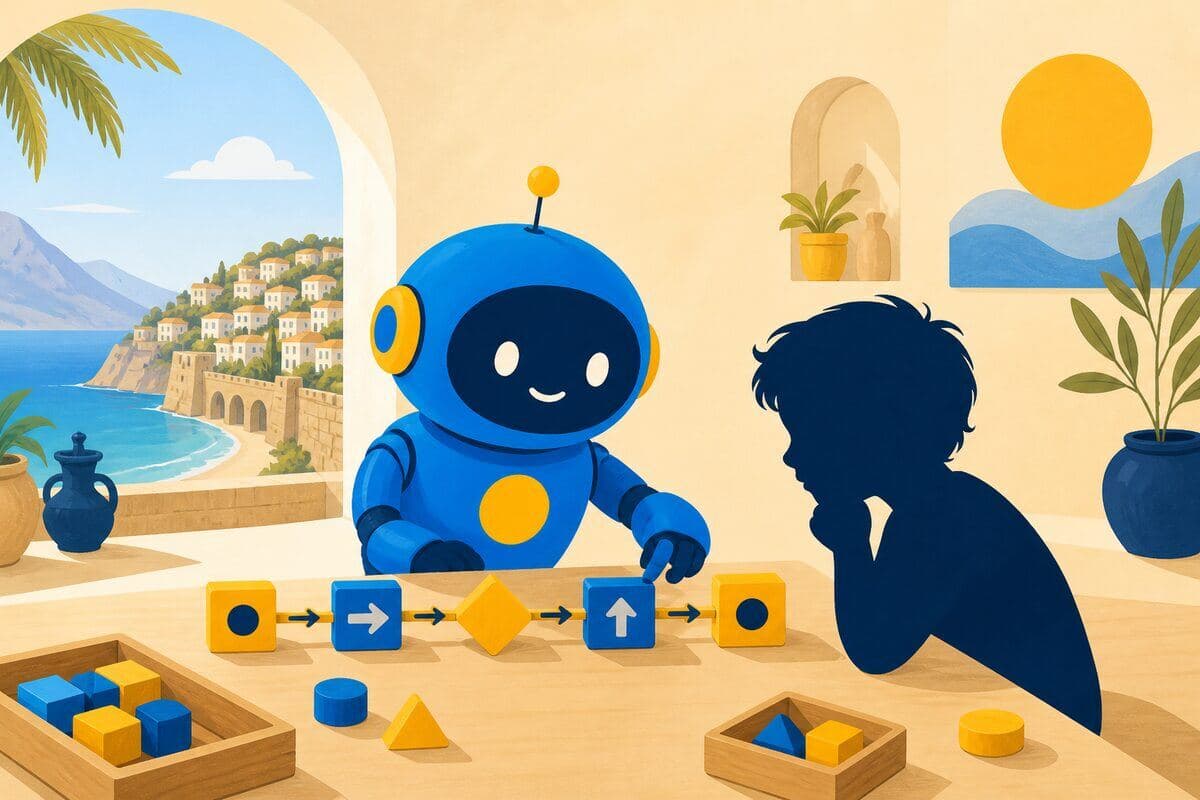
“Teach my child AI” sounds clear, but in practice every age needs a different path. A six year old and a fifteen year old do not use the same tool. AI education for children is not about opening a ready made chatbot. It is about growing the ability to break a problem into parts, to see patterns and to test the result.
The first step: thinking, not a tool
With young children the goal should not be “write Python”. The goal is for ideas such as order, condition, repetition and prediction to settle in through play. That is why Zekaland’s age 6 level is screen free. Physical games build a feel for algorithms.
The tools (Scratch, App Inventor, Python) come later. A tool makes thinking visible, and it does not replace thinking.
A rough frame by age
| Age band | Focus | Typical result |
|---|---|---|
| 6 | Screen free play, direction, patterns | A physical activity |
| 7 to 10 | Block coding and simple classification | A visual project |
| 11 to 14 | An introduction to mobile and ML | An app or a model trial |
| 15 to 17 | A project with Python and APIs | A small working app |
This table is a roadmap, not a list of promises. Even if your child is the age in the table, they do not need to skip the earlier step.
Be clear about what you expect as a parent
A realistic goal is that your child learns to ask “why did it not work?”. An unrealistic goal is the claim of an “AI expert” in three weeks. A good programme rewards patience and does not sell false urgency.
If you want to go forward face to face in Alanya, take a look at the AI school in Alanya guide and the course curriculum.
Sources and further reading
Discover the right technology path for your child
Explore Zekaland’s age based coding and AI programmes, or leave an enrolment request.